




Why Invest in Early Quant Education?
Every quantitative firm must decide how seriously it takes early education. While many claim to invest in development, not all early quant programs are created equal.
Designing a serious education program requires deliberate resource allocation and long-term thinking. In this article, we outline the key factors that influence that decision and why Susquehanna places such a strong emphasis on early quant education:
- Scale
- Longevity of employees
- Diversity of approaches and expertise
- Interconnectedness across desks
Scale
We begin with the most obvious constraint: scale.
Investing meaningfully in education requires size—both in terms of the current quant team and the pipeline of incoming quants. High-quality training depends on experienced quants dedicating time to teaching, mentoring, and designing curriculum. That time comes at a real opportunity cost. Only firms with sufficient scale can consistently commit senior resources to developing new hires.
Longevity of Employees
Education consumes resources in two ways. First, senior quants invest time in teaching. Second, new hires are not immediately focused on producing revenue, but are instead investing in themselves.
From a firm’s perspective, the trade-off between education and immediate productivity looks like the plot below.
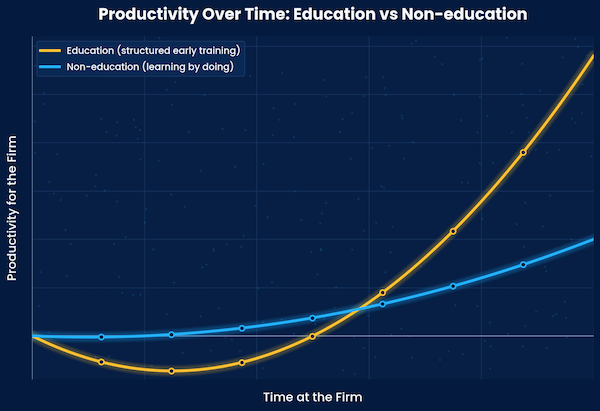
Without formal education, productivity ramps up more quickly. There may be a small initial dip as new hires acclimate, but they begin contributing sooner as growth is steady and incremental.
With structured education, the short-term cost is larger. Productivity declines more meaningfully at first because time is deliberately allocated to training. However, post-education, the growth trajectory steepens significantly and the long-term slope is higher.
The key question is retention. If talent stays, the education curve dominates over time, but if talent leaves too quickly, the investment is not fully realized. In that context, Susquehanna’s extensive early education is optimal.
Diversity of Approaches and Expertise
Modern quantitative trading requires wearing many hats. We must understand data; trading microstructure; statistics; finance; technology (software and sometimes hardware); and machine learning.
Financial data is noisy, adversarial, and constantly evolving. We rarely hire individuals who already possess deep expertise across all these domains. Even experienced quants must continually reinvent their toolboxes as markets, technologies, and models change.
Structured education accelerates this adaptation by building shared foundations while expanding individual skill sets.
Interconnectedness Across Desks
This is an area where Susquehanna takes particular pride.
While individual desks face unique challenges, there are deep commonalities across strategies—data pipelines, risk frameworks, execution constraints, and modeling trade-offs. An insight developed in one context can often be valuable in another.
Education strengthens this network effect. Early training introduces new hires to researchers and traders across teams, building relationships from day one. It creates a shared vocabulary and shared intuition that makes collaboration easier.
Conclusion
While building an education program is an effective way to attract strong candidates, the factors above must also be in place to align the interests of new hires with those of the organization they are joining. Susquehanna’s commitment to education is not just a branding exercise, but a recognition of the structural advantages underpinning our firm.