




In modern quantitative finance, the phrase "time is money" is no longer a metaphor. It is a technical specification. As machine learning architectures grow in complexity, they often collide with the harsh reality of execution speed. For high-frequency trading and real-time risk engines, a superior predictive signal is worthless if it arrives late.
In electronic markets, races occur when multiple participants react to the same signal. Research indicates the gap between the winner and the first loser can be as narrow as 5–10 microseconds (Aquilina et al., 2021). While a massive transformer might offer high accuracy, its 10ms+ inference time makes it a liability. This is where model distillation becomes a competitive necessity.
What is model distillation?
Model distillation is the process of transferring the "intelligence" of a large, computationally expensive teacher model into a lean student model that can run ultra-fast. The technique was pioneered by Hinton et al. (2015) to improve model performance on classification problems, and it has since been applied to regression problems as well (e.g. Takamoto et al., 2020; Gou et al., 2021).
To understand the basic mechanism of model distillation, it helps to view it as a supervised learning refinement process. In standard training, a model learns from static labels. In distillation, the student model learns from a "living" interpretation of the data provided by the teacher.
The system consists of two distinct models:
- The teacher (\(T\)): A high-capacity, pre-trained model. The teacher is frozen during the distillation process; it acts only as a reference.
- The student (\(S\)): A compact model with significantly fewer parameters. This is the only model that undergoes training during the distillation phase.
When an input \(x\) is fed into the system, it passes through both models simultaneously:
- Teacher path: Generates a prediction \(\hat{y}_T\), which contains the teacher's nuanced understanding of the input.
- Student path: Generates its own prediction \(\hat{y}_S\).
The objective function of the student combines two types of supervision:
- Ground truth supervision: Learning from the actual labeled data \(y\).
- Teacher supervision: Learning from the teacher's predicted values \(\hat{y}_T\).
The combined loss is often expressed as:
\(L = (1 - \alpha) \cdot \text{Loss}(y,\ \hat{y}_S) + \alpha \cdot \text{Loss}(\hat{y}_T,\ \hat{y}_S)\)
where \(\alpha\) balances the influence of the teacher versus the actual data.
Why does model distillation work?
The core mechanism of model distillation rests on two distinct properties:
- Target smoothing: Real-world regression labels are often noisy and contain outliers — in financial data especially. A well-trained teacher model, regularized during its own training, learns to suppress these fluctuations and approximate the smoother underlying function that generated the data. Its predictions therefore act as soft targets that are systematically closer to the true data-generating process than any individual noisy observation. By training against these denoised targets rather than raw labels, the student benefits in two compounding ways. First, it is no longer penalized for deviating from corrupted observations — the supervision signal it receives is a cleaner proxy for ground truth, so the student's parameters are pulled toward a more generalizable solution from the start. Second, the loss landscape seen by the student becomes better-conditioned: because the teacher's predictions vary smoothly across the input space, the gradients the student receives are more consistent across minibatches, training is more stable, and convergence is faster than it would be under the erratic pull of raw noisy labels. In this sense, the teacher performs an implicit regularization step — not by constraining the student's architecture, but by cleaning the signal before the student ever sees it.
- Dark knowledge: In classification, rather than supervising the student on one-hot hard labels, the student learns from the teacher's full predicted probability distribution across all classes — the so-called "dark knowledge" embedded in the teacher's output logits. This soft distribution encodes inter-class similarity structure that a binary label discards entirely: a prediction that assigns 15% probability to "dog" when classifying a cat tells the student something fundamental about the geometry of the class manifold that a hard label simply cannot. It provides a far denser supervisory signal, one that reflects the teacher's learned understanding of how categories relate to one another. In regression, the analogue is the structural information encoded in how the teacher's predictions vary across the input space. A teacher that has learned a complex nonlinear function produces outputs that change rapidly in high-curvature regions and smoothly elsewhere — implicitly communicating where the function is simple and where it demands precision. A student trained against these outputs receives a spatially calibrated supervision signal that a collection of independent point labels cannot provide. In both settings, distillation extracts supervisory signal that raw labels simply do not contain.
Case study: regression distillation on synthetic data
To make these ideas concrete, we ran a controlled regression experiment. The teacher is a wide MLP (64×64×64 hidden units) trained with weight decay on 2,000 synthetic samples at a range of signal-to-noise ratios; the student is a much smaller MLP (either 16×16 or 4×4 hidden units). SNR is defined as the ratio of signal variance to noise variance: \(\text{SNR} = \text{Var}(\text{signal}) / \text{Var}(\text{noise})\), where higher values mean cleaner labels. All results average over 200 independent seeds with error bars showing ±1 standard error.
Does distillation help?
The first question is simply whether distillation improves on vanilla supervised training for both student architectures. The learning curves below compare three models — teacher, student (supervised), and student (distilled at the best \(\alpha\)) — averaged over 200 seeds at SNR = 0.5.
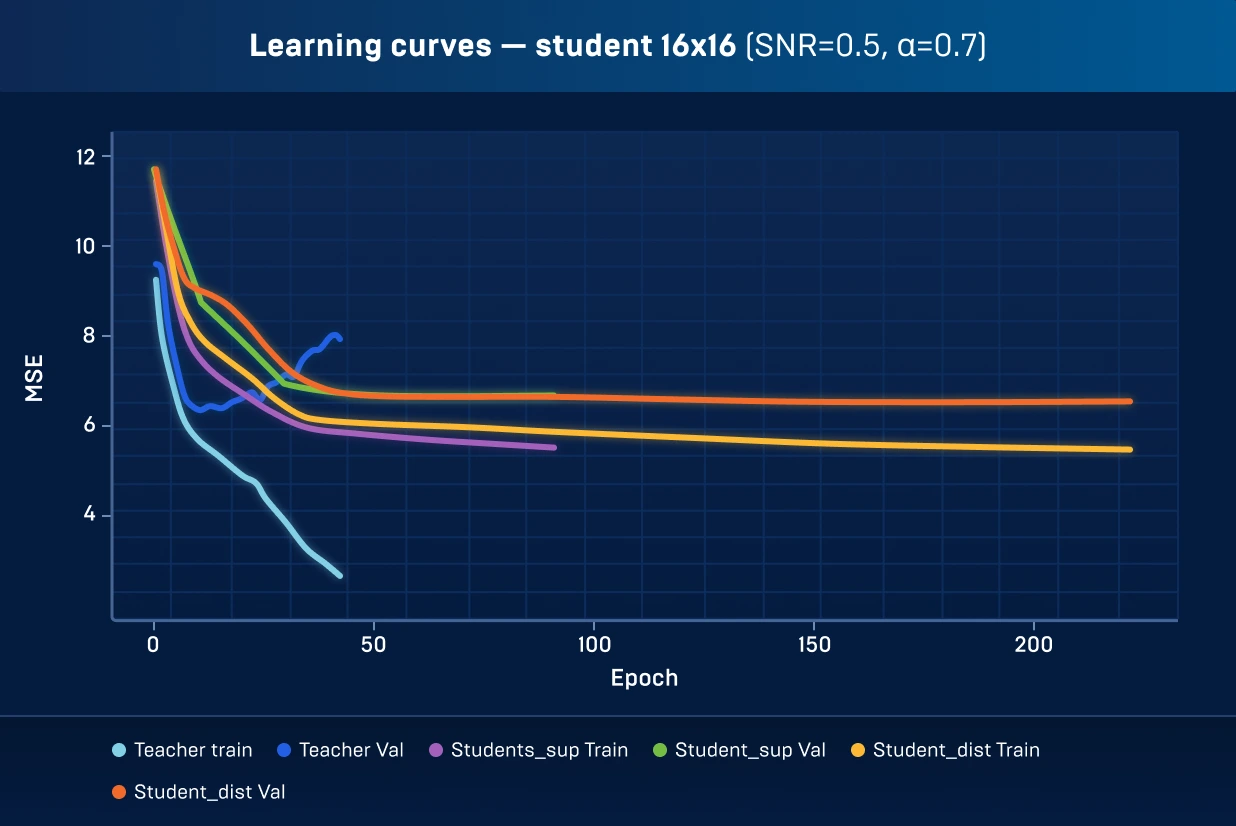
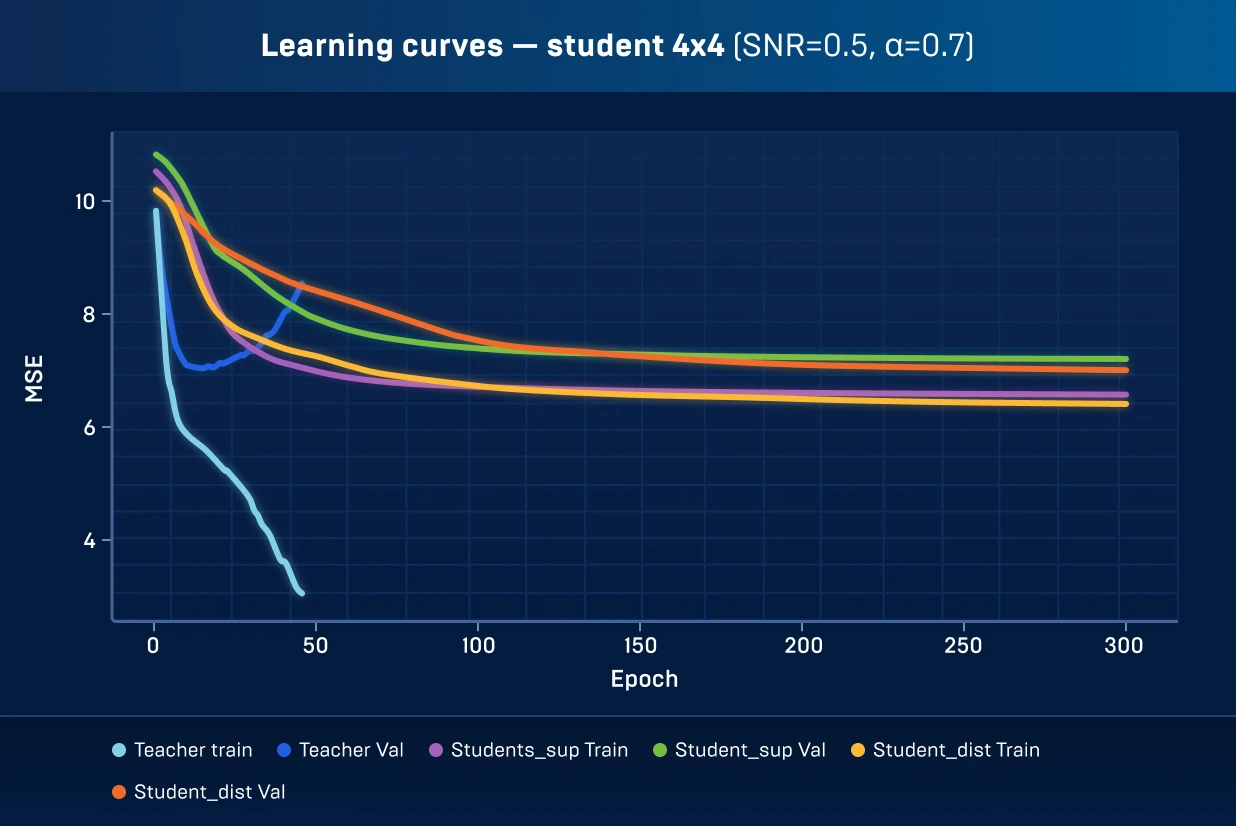
The benefit is visible for both architectures, but the gap is larger for the capacity-constrained 4×4 student. When the student has fewer parameters, it relies more heavily on the teacher's smoothed signal to navigate the loss landscape — the teacher effectively tells the student where the hard regions are before it gets stuck.
Effect of the mixing weight \(\alpha\)
The \(\alpha\) parameter controls how much the student learns from the teacher versus the raw labels. The plots below sweep \(\alpha\) from 0 (pure supervised) to 1 (pure teacher-matching) and report mean test MSE with error bars.
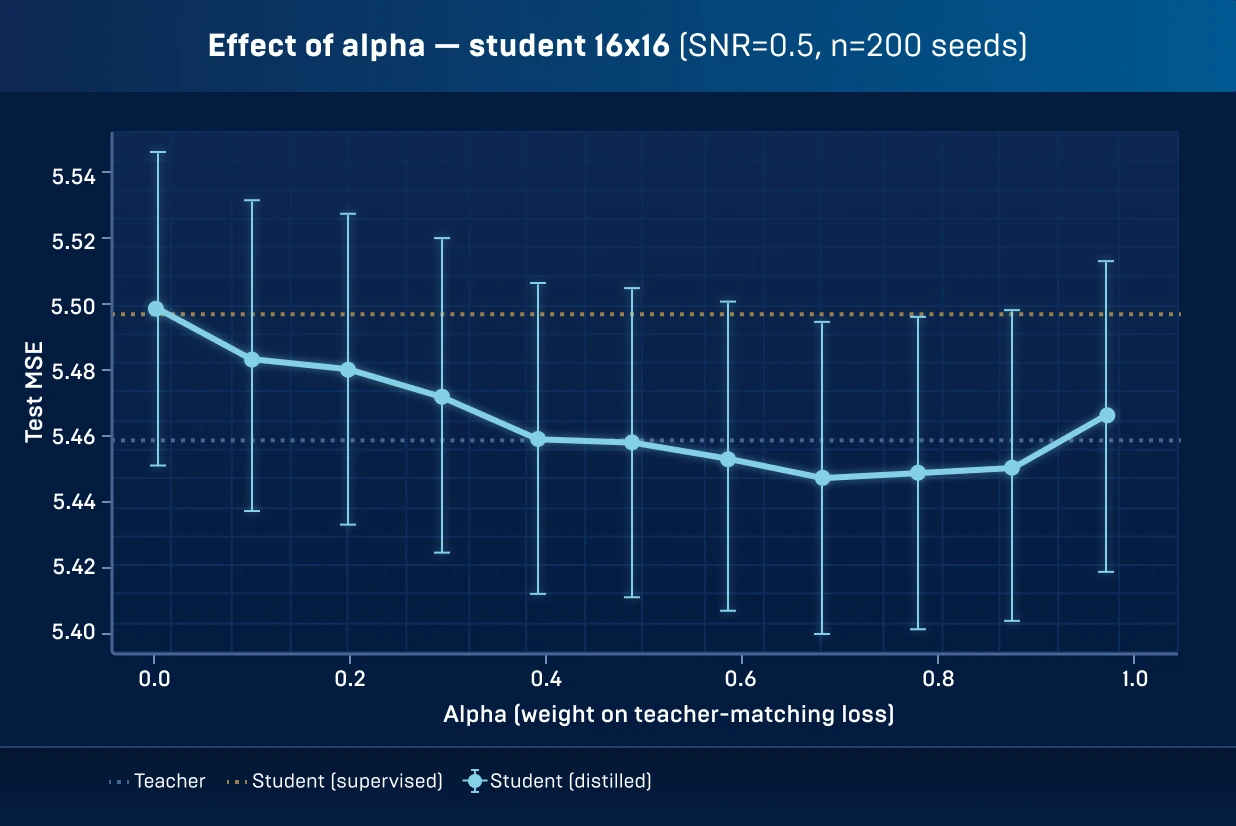
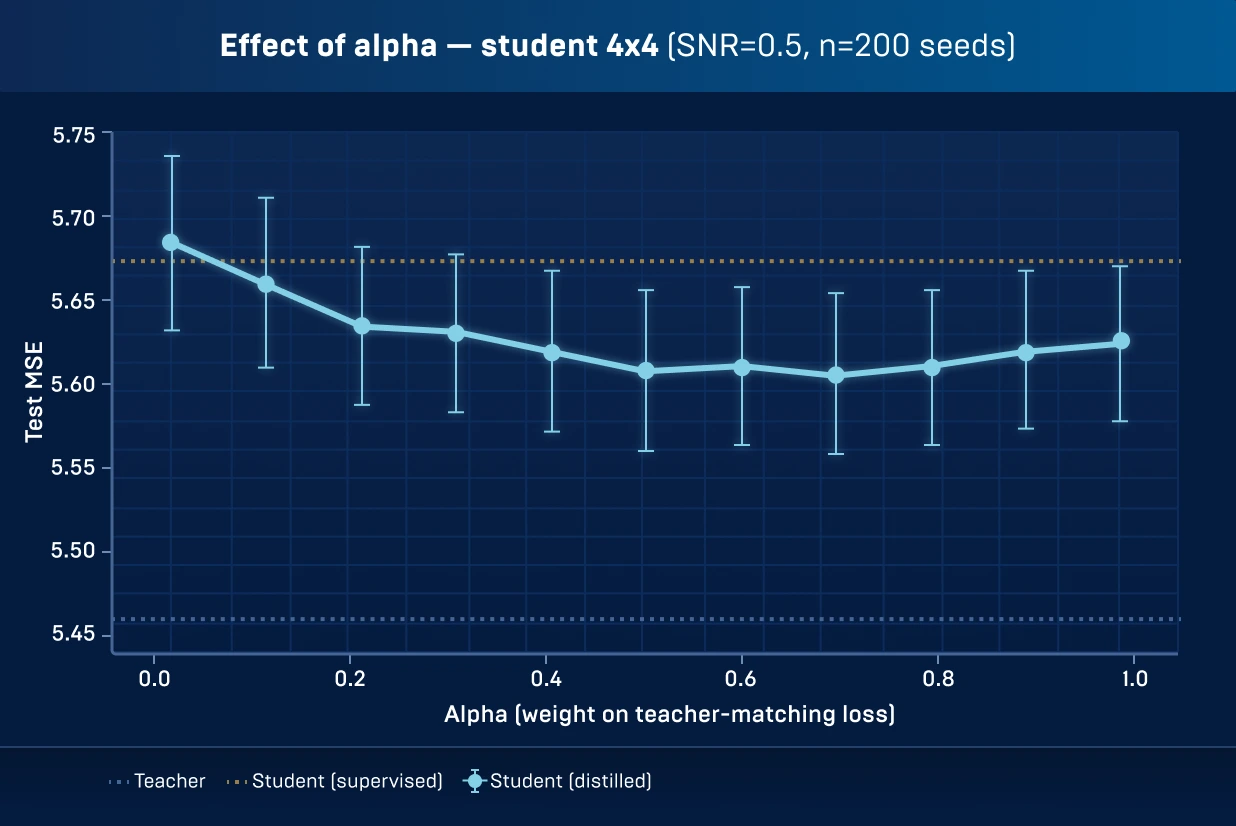
Both architectures show an interior optimum — neither pure supervision nor pure teacher-matching is best. The 4×4 student's curve is flatter, with positive benefit maintained across a wider range of \(\alpha\) values. For the 16×16 student, the benefit is more concentrated around the optimum and begins to degrade at high \(\alpha\) as the student stops learning from the raw labels entirely.
Robustness across noise levels
The heatmap-style bar charts below show the distillation ratio (student distilled MSE / student supervised MSE) across \(\alpha\) values, separately for each SNR level. Values below 1.0 (the tomato reference line) mean distillation helps.
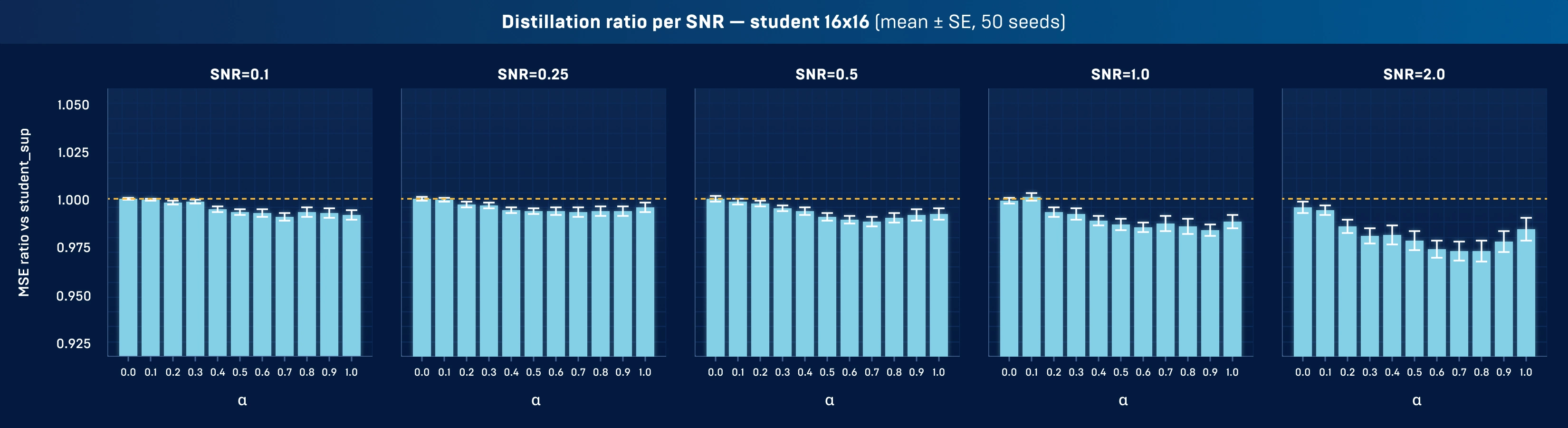
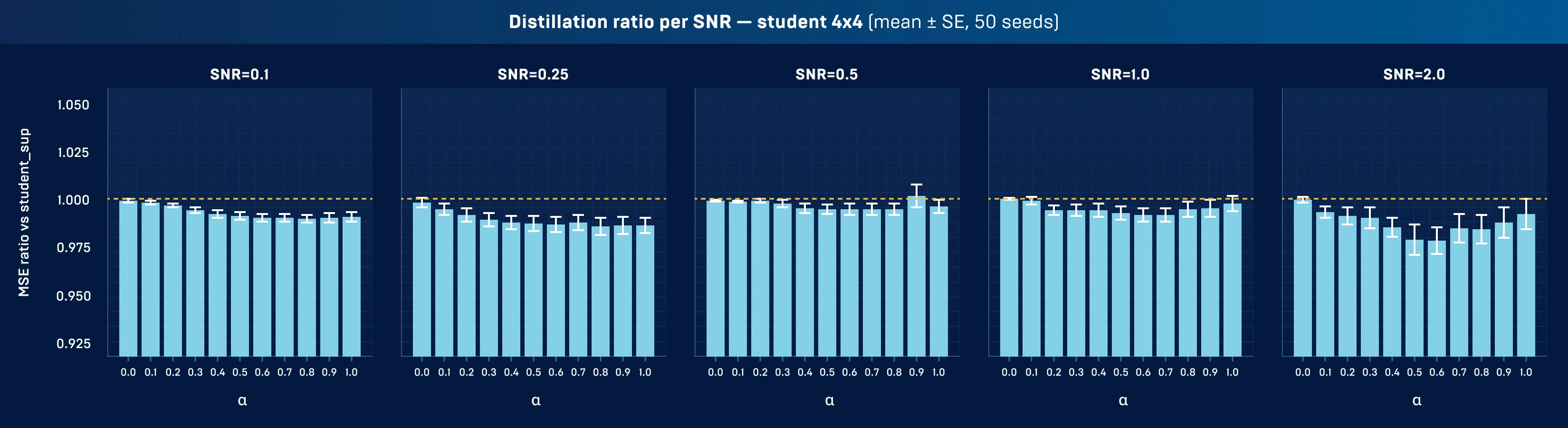
Distillation helps most at low SNR for both architectures — precisely where the raw labels are noisiest and the teacher's smoothing effect is most valuable. At high SNR the labels are already clean, the teacher offers less of an advantage, and the optimal \(\alpha\) shifts toward zero. The 4×4 student shows a stronger and more consistent benefit across all noise levels, confirming that distillation is especially effective when the student's capacity is the binding constraint.
Intrinsic dimensionality and the capacity sweet spot
So far we have shown that distillation helps, especially under noisy labels and limited student capacity. But why? One natural hypothesis is that teacher targets make the student's optimization problem easier — that fitting the teacher's smoothed predictions demands less effective model capacity than fitting the raw noisy labels. If this is true, it would explain why a capacity-constrained student benefits so much: distillation does not just give the student more information, it gives it information arranged in a form its limited capacity can actually absorb.
To test this hypothesis, we use intrinsic dimensionality (Li et al., 2018). The technique constrains the student to optimize only within a randomly chosen \(d\)-dimensional subspace of its full parameter space, then varies \(d\). The minimum \(d\) at which the student can fit a target acts as a proxy for that target's intrinsic difficulty: targets learnable at low \(d\) require less effective capacity. We apply the procedure to two targets — the teacher's predictions and the raw noisy training labels — and compare test MSE at each \(d\). Lower MSE at the same \(d\) means the target is easier to learn.
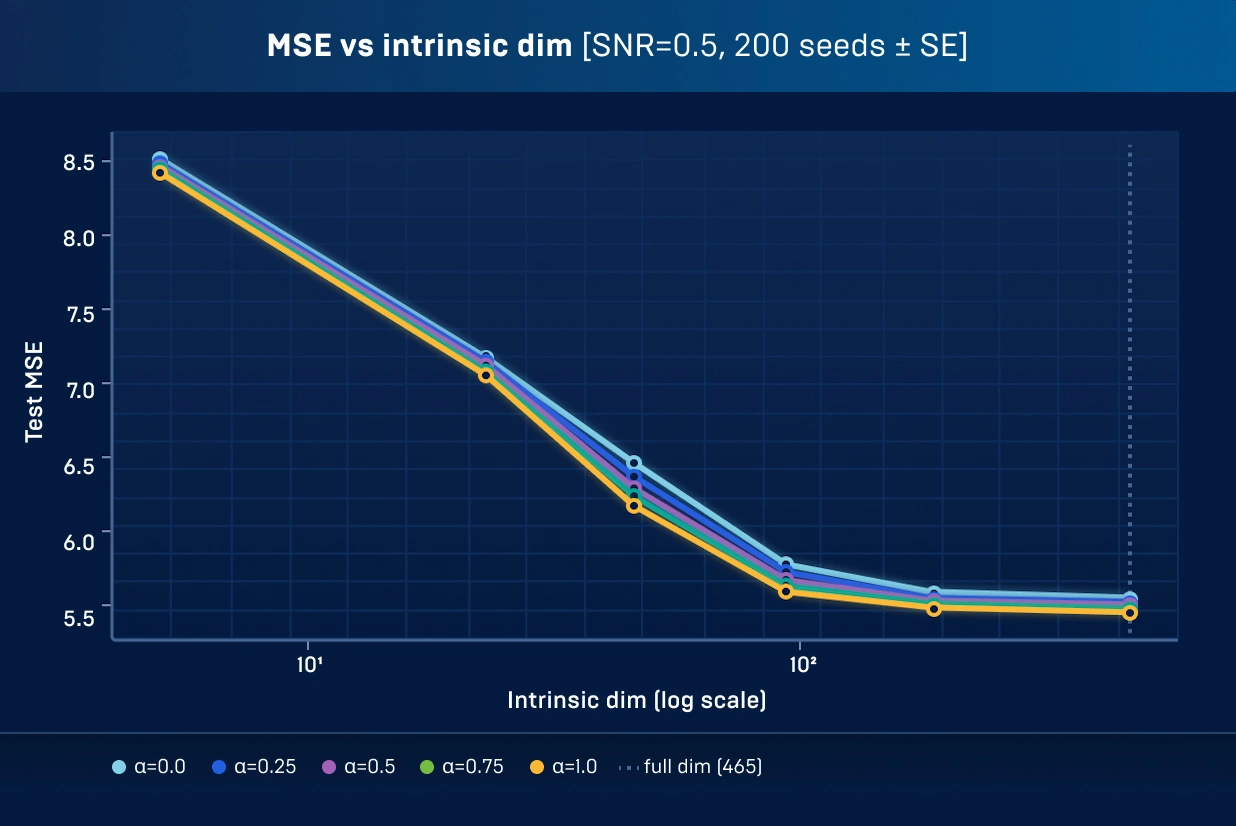
The results support the hypothesis. The teacher's predictions (yellow line) are consistently easier to fit than the noisy training labels (light blue): at every intrinsic dimension we tested, the yellow curve sits at or below the purple one. By smoothing out label noise, the teacher produces a target that demands less model capacity to approximate, and the gap is widest around an intrinsic dimension of roughly 40 — where the difficulty of learning teacher targets versus noisy labels diverges most. This reframes the earlier findings: distillation's effectiveness is not just about transferring more information, but about reshaping the optimization problem into one a capacity-constrained student can actually solve. Whether distillation helps, and by how much, is therefore a joint function of target easiness — set by SNR and by whether the supervision comes from the teacher or the raw labels — and the student's effective capacity; neither alone determines the outcome. In practice, the student's capacity is rarely a free design choice: in latency-sensitive settings like high-frequency trading, it is pinned down from above by the microsecond budget the model must fit into. Distillation is most valuable precisely in this regime, where the student is forced to be small and the teacher's smoothed targets do the work that extra parameters otherwise would.
Other benefits
In the financial sector, where execution speeds determine the viability of a strategy, model distillation is more than just a compression trick — it is a powerful technique that can significantly reduce inference latency. Additionally, it offers several other specific advantages.
- Deployment to resource-constrained hardware: High-frequency trading environments often require deploying models directly on hardware accelerators — whether FPGAs or GPUs — where memory capacity and bandwidth place hard limits on model size. Distillation allows a quantitative researcher to take a massive, research-grade model and compress it into a leaner architecture that can be fully loaded and executed on-chip, without the overhead of offloading weights or streaming data from external memory. This enables complex AI models to run entirely within the hardware's native memory hierarchy.
- Denoising volatile market signals: Financial data is notoriously noisy. By training the high-capacity teacher model with heavy regularization, it can act as a signal filter. When the student is trained to mimic the teacher's smoothed outputs rather than the jagged, raw market ticks, it often exhibits better generalization. The student ends up being more stable during market turbulence because it was taught to ignore the noise by the teacher.
Recent research directions
Active research on distillation has moved well beyond the original Hinton et al. (2015) formulation, with several distinct threads emerging. One line of work revisits the distillation objective itself — examining how temperature scaling bridges logit matching and probability distribution matching, and showing that asymmetric temperature schemes introduce implicit Rényi entropy regularization that improves student generalization (Zheng & Yang, 2024). A separate thread focuses on adaptive teaching, recognizing that different tokens or samples have different learning difficulties, and that a fixed distillation objective treats them uniformly at the cost of performance — motivating sample-wise or token-wise reweighting of the distillation signal (Zhong et al., 2024). On the structural side, cooperative distillation frameworks allow multiple models to act simultaneously as both students and teachers, transferring knowledge only in regions where a given model has a comparative advantage, relaxing the strict asymmetry of the classical teacher-student setup (Livanos et al., 2024). Finally, with the rise of foundation models and LLMs, distillation has been extended to entirely new modalities and architectures, raising open questions around how to faithfully transfer emergent capabilities — such as reasoning and in-context learning — that are not easily captured by output distribution matching alone (Mansourian et al., 2025).
Conclusions
As financial models become more sophisticated, the bottleneck moves from what we know to how fast we can act on it. Model distillation provides the essential bridge between high-fidelity research and real-time execution, ensuring that the most advanced AI logic can survive the "race to zero" in the world's most demanding environments.
By transforming heavy, resource-intensive architectures into nimble, production-ready students, firms achieve a triple victory: they preserve most of the predictive power of state-of-the-art models, minimize the physical and electrical footprint of their infrastructure, and — most importantly — capture alpha that would otherwise be lost to the overhead of slower systems. In an industry where a five-microsecond delay separates a profitable trade from a missed opportunity, distillation is no longer just an optimization; it is a prerequisite for survival.
References
- Aquilina, M., Budish, E., & O'Neill, P. (2021). Quantifying the High-Frequency Trading Race. Quarterly Journal of Economics.
- Hinton, G., Vinyals, O., & Dean, J. (2015). Distilling the Knowledge in a Neural Network. arXiv:1503.02531.
- Takamoto, M., Morishita, Y., & Imaoka, H. (2020). An Efficient Method of Training Small Models for Regression Problems with Knowledge Distillation. arXiv:2002.12597.
- Gou, J., Yu, B., Maybank, S. J., & Tao, D. (2021). Knowledge Distillation: A Survey. arXiv:2006.05525.
- Li, C., Farkhoor, H., Liu, R., & Yosinski, J. (2018). Measuring the Intrinsic Dimension of Objective Landscapes. arXiv:1804.08838.
- Zheng, K., & Yang, E. (2024). Knowledge Distillation Based on Transformed Teacher Matching. arXiv:2402.11148.
- Zhong, Q., Ding, L., Shen, L., Liu, J., Du, B., & Tao, D. (2024). Revisiting Knowledge Distillation for Autoregressive Language Models. arXiv:2402.11890.
- Livanos, M., Davidson, I., & Wong, S. (2024). Cooperative Knowledge Distillation: A Learner Agnostic Approach. arXiv:2402.05942.
- Mansourian, A. M., et al. (2025). A Comprehensive Survey on Knowledge Distillation. arXiv:2503.12067.